
Most AI tools look the same on the surface: a box to type into and a helpful answer a few seconds later. What differs is everything behind the box. Where your words travel, who can read them and how long they stay are decided by the provider, and those details are rarely on the front page.
The good news is that you do not need a technical background to find them out. Five plain questions will tell you nearly everything you need to know about any AI tool, whether it is a chatbot, a writing assistant or a feature tucked inside software you already use.
Why ask at all?
Your team is probably already using AI for drafting, summarising and research. That is a sensible thing to do, and the aim here is not to slow anyone down. It is to make sure the people choosing the tools can explain the choice.
Over 23 years as a technical lead in large companies and government departments, I saw the same pattern again and again. Tools that were adopted with clear answers were used confidently. Tools adopted without them were either used quietly or banned later, and neither outcome helps anyone. A few minutes of questions at the start avoids both.
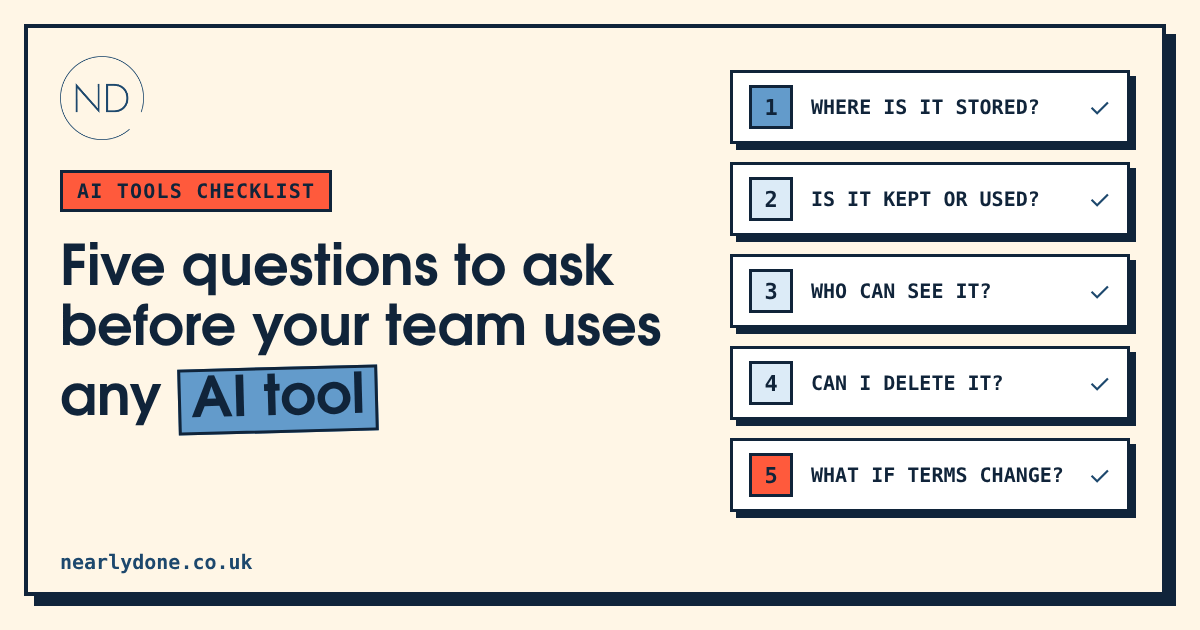
The five questions
1. Where is my data processed and stored?
Start with geography. Some providers process everything in one region, others spread work across several, and a few will not say. If a client or contract expects your information to stay in the UK, you need a specific answer, not a general reassurance.
2. Is my data kept, and is it used to train models?
Two separate points hide in this one question. The first is retention: are your prompts and files stored, and for how long? The second is training: can they be used to improve the provider’s models? Many business accounts switch training off by default and free accounts often do not, so check which one you are on.
3. Who can see it?
Beyond you and your team, who else has access? Look for staff at the provider, subcontractors and any third-party services involved in running the tool. A good provider will list these openly. If the answer is vague, that tells you something too.
4. Can I get it back, and can I delete it?
It is easy to put information into a tool and surprisingly hard to take it out again. Ask what happens to your data if you cancel, whether you can export it and whether deletion is genuine and complete or simply hidden from view.
5. What if the terms change?
Terms and settings are updated regularly, often with a short email that nobody reads. Ask how you will be told about changes and whether you can leave without penalty if you do not like them. This matters most for tools that become part of everyday work, because the longer you rely on them, the harder it is to walk away.
What good answers look like
A good answer is specific, written down and easy to find. It names a region, gives a retention period, states clearly whether your data trains anything and says how to delete it. If you have to hunt through several documents to piece the answer together, treat that as information.
It also helps to know that the answers change as you move up the four levels of control I work with. At Level 1, the standard cloud tools, the answers come from the provider’s terms. At Level 2, hosted private models, they are stronger, but you are still relying on someone else’s word. At Level 3, a private model on a cloud server you control, you choose the region and the access. At Level 4, a computer on your own premises, the answers to all five questions are simply “here, and only us”.
A word of reassurance: asking these questions does not mean you will find problems. Often the answers are perfectly acceptable for the work you have in mind, and then you can use the tool with confidence. Occasionally they show that a tool suits public-facing tasks but not confidential ones. Either result is useful, because it lets you match each type of work to the right tool instead of guessing.
None of these is wrong. The right level depends on what you put in and who is entitled to see it. The questions just let you make that choice with your eyes open.
Turning the questions into a habit
The easiest way to use these questions is to ask them once, write the answers down and keep them somewhere your team can find. After that, each new tool only needs a quick comparison against the same list.
- Keep a simple register of the AI tools your team uses, official or otherwise.
- Record the answers to the five questions beside each one.
- Agree which kinds of information may go into which tool.
- Review the list whenever a provider changes its terms, or twice a year.
It also makes onboarding easier. When someone new joins, or a colleague wants to try a different assistant, there is already a shared standard to point to. People tend to follow clear guidance happily, and they rarely need persuading when the reasons are written down in plain English.
Within an afternoon you will have something most organisations lack: a clear, honest picture of where your data goes. That picture is what clients, partners and insurers increasingly want to see, and it is far easier to build now than to reconstruct under pressure later.
My AI Readiness Checklist walks through this in more detail and shows where you currently sit across the four levels. It is free and takes about ten minutes.
Let me do the audit for you
Working through these questions is something I do for clients as a service. I will list the AI tools your team uses, put the five questions to each one, record the answers and show where you sit across the four levels of control. You receive a clear, written picture that you can keep, share with clients and update as tools change.
It is a good fit if you would rather spend your time on your own work, or if you want an independent view from someone who has asked these questions inside large organisations for 23 years. From there, I can also help you choose the right level, and set up a private self-hosted model at Level 3 or 4 if that suits you.
Start with a conversation
If you would like me to run the audit, or simply talk it through first, I would be glad to meet for a coffee. I am a one-person consultancy based in Coventry, so you will be talking to me directly, and there is no obligation beyond the conversation.